Tampilkan postingan dengan label hulls. Tampilkan semua postingan

Fine Lines and Lapstrake Clinker Hulls

Jumat, 22 Juli 2016

I was having a discussion recently with one of my sons about which hobby activity was the most fun. We have far too many hobbies, but flying and sailing are close to the top. Well, we both decided that there was no contest - dinghy sailing came out as number one.

Where I live, the biggest problem with sailing is exposure to the savage sun, but running a close second is being continually doused by water as you drive to windward. Yes, I know that we have a nice climate on the east coast of Australia (at least as far north as we are), but for a large part of the year the water is frequently very cold when it hits a hot body!

Most of the boats that I have sailed have had relatively blunt forward sections, and they tend to bash water into the air when butting into a wave, and the wind blows it back directly over the crew.

Hard to windward with a deep reef tied in - relatively smooth water as we exit the harbour, but we are still getting wet!
There are plenty of advantages in having full sections forward, such as adequate buoyancy when running down waves, and the ability to move forward in the boat while still retaining reasonable trim. In some boats where load-carrying is critical, a very broad bow is essential - for example a praam dinghy

My Alby design - lots of carrying capacity in a short hull
The problem is that the disturbed water pushed up by a blunt boat - at least in a dinghy - consumes power, and as previously mentioned, bashes water up into the wind so that it can wet the crew efficiently.

This is a nice design I built a few years back, but you can see that she pushes up a lot of water, even in light conditions

Here is another good example - a really nice design, but pushing up lots of water.
In both of the above photos, the boats were drawn by exceptionally good designers, and the shape ended up the way it did for important reasons. But it does demonstrate the point Im making about the water.

When I was asked to design Phoenix III, I really wanted to keep the bow fine. In fact, it has become a bit of an obsession with me, although I do change my attitude when necessary (e.g. Alby and Whimbrel).

Phoenix III showing her fine forward sections
My reasons for going down the path of fine forward sections include: -
  • Dryness when pushing to windward;
  • Reduced pounding - something which is very important in a small and light-weight boat;
  • Easily driven hull - particularly when under oars
Paul Hernes in his Phoenix III under oars - he is too busy smiling, and should be rowing faster!
One of my favourite methods of construction is glued-lapstrake (or glued-clinker). This system is only possible if the planks are made of plywood, because natural timber planks lack cross-grain strength and will crack where the thickness of the planks changes from double to single. That is why traditional clinker hulls have lots of closely-spaced bent ribs, and have their plank laps riveted or clench-nailed - the ribs provide cross-grain strength, and the mechanical fastenings allow the planks to move relative to each other as the boat shrinks and swells in changing conditions. Plywood has almost equal strength in all directions, and can be glued at the lap - this produces a strong, stress-skin hull which requires few, if any, internal frames. The glued laps form an integral "stringer" which further strengthens the hull.


A clean and open interior

A wonderful side-effect of the lapstrake construction method is that the laps produce a series of "spray rails" on the external surface of the hull.

Fine forward sections and prominent laps on my Periwinkle design
The combination of the fine lines and the overlapping planks makes for a dry ride in most conditions.

Here is a good example of the effectiveness of the sharp forward lines and the "spray rail" action of the laps. This is another photo of Periwinkle.
As with all things, there are drawbacks. Any boat with fine lines forward (or aft for that matter) needs to be properly trimmed, as they are sensitive to weight distribution.

Here, the crew of Periwinkle is a little too far forward for the conditions. In gentle winds their position would be ok, but I think the big mainsail was driving her down somewhat at the bow. However, she is still going nicely!
Every boat is a compromise, and there is a place for all different sorts of hull shapes. The more more you understand about hull-forms and construction methods, the easier it will be to make a decision about what is right for your circumstances.
Read More..

Thoughts on V Bottomed Hulls

Minggu, 05 Juni 2016

There is a lot of prejudice about flat-bottomed hulls, even though ones of good design can make excellent boats. But in western culture there is a far greater acceptance of the V-bottomed hull-form. I guess it is just a case of what we are used to seeing - westerners are familiar with the V-bottomed form and see it as being quite normal, just as I imagine that Chinese and South-East Asian people would have little argument with the virtues of a flat-bottomed boat.

Flint showing her V-bottomed hull-form
More than anything, I believe that concerns about pounding prevent the wider acceptance of flat-bottomed hulls.

A good example of a flat-bottomed sailing hull - this one is a Green Island 15
Any light-weight boat will pound, but if well heeled over, a flat-bottomed hull will run softly because the sharp angle between the bottom and the topsides acts as a "V". But if the boat is upright pounding can be a real problem.

Ive designed a number of V-bottomed hulls, but my main reason for using this form has been to gain stiffness in the bottom panels. The V-bottom picks up stiffness because the bottom is broken into two halves, and the keel line is very stiff indeed due to the convexity of the bottom in two directions - somewhat similar to the strength in an eggshell, which would break easily if a flat panel, but is extremely strong for its weight when in a compound, convex shape.

That is me sanding the keel line of Flint. You can easily imagine how stiff the bottom is, even though it is made from 6mm (1/4") plywood. If it was a flat panel it would be very flexible if not supported by internal framing.
My primary concern with hard-chined hulls, regardless of whether they are flat-bottomed, V-bottomed, or multi-chined, is the matter of turbulence where the flow of water crosses the chine line. Without access to tank-testing or sophisticated Computational Fluid Dynamics (CFD) programs, my assessment of correct hull design for hard-chined forms has been based on intuition and common sense backed-up by insights Ive gained from the writings of the late Philip C. Bolger.

One method of reducing turbulence around the chine is to keep the chine out of the water altogether - both Jim Michalak and Phil Bolger have used this technique a number of times - but the problem with that is it generally works well only if the boat is a light displacement design intended to run on an even keel e.g. rowing boats and power boats.

When more displacement is required, I use a different approach. A good example for discussion is my Alby design, which is a short pram dinghy designed to be short, but able to carry a heavy load. She was designed for my friend, Allan Burke. In order to maximise the displacement (therefore increase the carrying capacity), I used a lot of keel rocker, and reduced the angle of the "V" in the bottom amidships to only about 3.5 degrees. However, in order to reduce pounding, I twisted the bottom panels to give a relatively sharp "V" at the waterline foreward and aft - 18 to 20 degrees of deadrise.


In the drawing above, you can see how the chine-line (drawn in red) sweeps down strongly from the bow and stern to the lowest point amidships. The resulting hull is almost flat-bottomed amidships but quite well Vd at the bow and stern. I could have made her totally flat in the middle, but I left enough "V" to give the "eggshell" stiffness of a convex shape.

Some people will tell you that running a chine deeply into the water will cause excess turbulence and drag, but that is only the case if the hull is incorrectly shaped in 3D. You must consider a boat shape in profile, plan and body plan (i.e. end elevation) to get some idea of how the water will flow.


Above you can see the same hull viewed in body-plan . See how the designed curve in the topside panels and the bottom panels has resulted in a clean and well-streamlined chine-line (drawn in red)?


Now look at the same hull heeled at 20 degrees. The chine-line is forming a beautiful "V" with very little to cause turbulence, or to hold the boat back. This is one of the primary reasons why a well-designed pram or scow can be so fast - particularly in flat water.

This may give a clearer idea of how well the shape will slip along with minimal turbulence.
The only way to achieve the same effect on a sharp-bowed boat is to run the chine very high at the bow. An excellent example of this approach is Jack Holts Mirror 16 design.

Mirror 16 showing chine-line. (courtesy Terence, Boatdesign.net)
In contrast, have a look at a hull with a hard chine and the chine-line left low at the bow - you can imagine how much turbulence and resistance would be generated by the chine (drawn in red) being forced forward through the water.


These are just my own thoughts, but Im sticking with them at this stage.
Read More..

Discussion about Flat Bottomed Hulls

Senin, 30 Mei 2016

As I expected, publication of an opinion on the subject of flat bottomed boats has resulted in some discussion. Graham brought up the matter of adequate rocker and running the forefoot above the waterline (see my previous post), and he used Phil Bolgers Black Skimmer as an example. Black Skimmer is one of my all-time favourite designs, by the way - I think she is a superb example of sophisticated simplicity, and even after thirty-one years of studying her shape and construction, I still find her to be awe-inspiring.

Here is a photo of Black Skimmer, copied from Woodenboat Magazine - I hope I havent infringed any copyright. She is close to being my absolute favourite design.
Dennis has written in with the following: -

Ross, I love it that you are discussing flat bottomed skiffs. I love em. My first sailboat was a Bolger Featherwind which exhibited the design principles you mention in your post. I am not so sure I agree about the curvature in bottom and sides. W/L length gets shortened, more of the bottom is exposed to waves and the pounding is obnoxious (this is not to say that the boat was not a blast to sail). How would John Atkins Lark (143" sailing skiff) stack up to your discussion? It has a fine entry, but the stem is immersed. It has good flare and I would bet that it does not pound the fillings out of your teeth while sailing in a chop. While I have not built and sailed another flat bottomed skiff since owning the Featherwind, I will probably do so one day because the nostalgia of that first boat has a powerful draw. Best, Dennis

I know what Dennis is talking about, and it is a good demonstration of how everything in boat design requires compromise. The shape which provides the excellent sailing behaviour (adequate rocker, matched curvature of the topsides and the bottom panel, forefoot run above the waterline) is very likely to pound badly when floating level.


There are plenty of flat-bottomed skiff designs around which have the forefoot immersed, and scores of William and John Atkin boats provide excellent examples to study. One of my favourite Atkin designs is Ration and she shows exactly what we are talking about.
Lines of Ration - courtesy of Motor Boatings Ideal Series - Chapman and Horenburger
Ration shows a rowboat which is less likely to pound in a small chop - immersed forefoot and very fine entry at the waterline and bottom - but she will still pound as soon as the waves get large enough to make the forefoot clear the water. The main problem is that the shape of the chine-line is such that there will be turbulence formed as the water running around the sides at the bow inevitably runs down and across the chine, and subsequently runs back across the chine in the aft sections (although this will be less of a problem than at the bow). A mitigating factor in this design is that the boat is relatively slim. It is in wide, flat boats that the problem is at its worst, causing excess drag and wild, unpredictable steering - particularly downwind.


To get an appreciation of what Im trying to describe, compare the shapes I show below: -

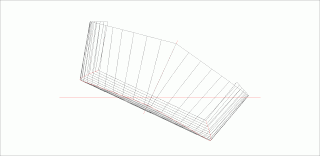
A typical flat-bottomed skiff with the heel of the stem immersed, and the bottom of the transom coming to above the waterline. Im only showing the body plan here, but the boat Ive drawn as the example is fairly long and slim.
The same boat heeled 25 degrees. In reality, the stern would probably be forced a bit higher and the bow lower than Ive shown here, which would make matters even worse.
A clearer view of the same boat. See how the chine line will generate turbulence and drag, and will tend to force the boat to round up.
For comparision, here is the underwater shape of the example I drew for the previous posting. While this is not a perfect shape by any means, it is vastly superior to the example shown above - but it will pound more when flat in a ripple.
It is all a matter of degree - the Featherwind mentioned by Dennis shows close to the ultimate in matching the curve of the topsides and the bottom - at least for a sharp-bowed boat - but she is best used as a sailing boat, or a rowing boat on flat water.
Read More..

Double Ended Hulls

Selasa, 24 Mei 2016

My good friend, Al Burke (Aviator, Boatbuilder, and Waterman extraordinaire) has written in with a comment about the previous post on Design Evolution.

Rossco,

While you are on hull forms & bottoms,you might like to comment on what sailing qualities to expect from a double-ender like the little 12 Peapod by Arch Davis featured in the current WB magazine.A pretty boat & a style which I just know has exercised your enquiring mind & generated a sketch or three of your own ideas.

Your experience with your Iain Oughtred sailing canoe would be a big help I trust,being of similar length but much narrower beam.

btw,Im posting as anonymous as my Google a/c keeps deleting my message when I try to send & tells me it is an "Input error" which my investigations have found is happening with anyone using Google a/c in IE9.

Al Burke


I dont have any photos of the Oughtred Macgregor under sail, but here is a picture which gives an idea of the hull shape
Ive sailed the Macgregor quite a bit in the past, and as long as the conditions are not too windy, she sails beautifully, being nicely balanced, easily driven by her small sail, and lively. Surprisingly, she can get up to windward quite well even without the leeboard being deployed. But, of course, setting the leeboard brings her to life on the wind.

Unfortunately, I have very little experience sailing larger double-ended boats, so I cant answer Als question with any authority. However, Im very interested in the hullform for several reasons: -
  1. A double-ended hull tends to have similar amounts of reserve buoyancy forward and aft of the centre-of-buoyancy and centre-of-floatation. In very simple terms, this means that you avoid the problem of a broad-sterned boat having the stern lifted by a wave and having the less-buoyant bow sections pressed underwater. In another example, you can have the situation where a broad-sterned boat is pushing into a short head-sea and the reserve buoyancy of the stern prevents the bow from lifting to the on-coming waves. In the same situation, a double-ender is much more likely to lift her bow as the similar-sized stern is depressed.
  2. When a sailing boat which has broad, relatively flat aft sections heels, the turn-of-bilge is forced down into the water, and as a result, the entire aft part of the boat is lifted by the buoyant stern and the bow is forced downwards. This is a situation which is frequently seen occurring on modern ocean racing yachts - the wide, flat sections aft allow these boats to achieve very high speeds when the sheets are eased, but the boat must be sailed as flat as possible. On the other hand, a double-ender is much more likely to retain proper fore-and-aft trim when heeled at substantial angles.
  3. When a small boat is heavily loaded, or is trimmed down by the stern, the transom is often immersed, causing excess drag and wild eddies. If double-ended, an overloaded or poorly trimmed boat will avoid much of the eddying and associated drag.
  4. Lastly, a double-ended dinghy can be pulled up a beach bow-first without having a wide, flat transom bashed constantly by breaking waves and powerboat wakes.
The stern of Periwinkle lifting as she heels with a light crew. The sheethand should move aft, and the mainsheet needs to be eased a little to get the boat down flatter. This hull was designed to be fast, but needs to be sailed flat to get the best from her.

Here you can see the same boat being sailed flat by her owner, John Shrapnel. It is a different point-of-sail, but note the way the bow has lifted .
 The problem is that nothing comes for free! A double-ender may have some nice characteristics of balance and sea-kindliness, but you pay a price. The sharp aft sections rob sail-carrying power compared with a transom-sterned boat of similar length. Also, I suspect that the curved surfaces of the leeward side of the double-ender - most particularly in the case of a boat with a high breadth-to-length ratio - will tend to induce weather-helm when the boat is heeled.

So, given that my sailing experience with double-enders is limited, here is my opinion. I think that the balance and seakindliness of the double-ender, allied with the load flexibility, make the form better suited to rowing dinghies than sailing dinghies. However, there is a place for a nicely shaped double-ender as a rowing boat with auxilliary sail. I dont have the knowledge to speak about larger boats with ballast keels.

A 15 ft x 4.5ft boat I modelled for my own use.


Another view of the same model. Note how I have used very firm bilges to try to retain sail-carrying power
Read More..

Sharpie Hulls and Fine Sections

Kamis, 25 Februari 2016

Graham has written a very interesting comment following-up on the last two postings. As it happens, it touches on a subject which is of great interest to me, as Im in the process of designing a boat which incorporates the very characteristics he mentions. This boat has come about because of a request from a customer, but she has been in my head for many years and some of the reasons that I am so interested in this hull type are illustrated by Grahams comment.

Hi Ross, Have really enjoyed the last couple of posts. I like thinking about the laps as spray rails, it added another dimension to what I thought of as simply a nod to tradition. On the matter of fine entry + flare I would like to make an observation - is this discussion of fine entry and flare dependent on hull type? I am thinking of flat bottomed sharpie hulls in particular. These hulls often have nearly plum or vertical sides, but are designed to be sailed with a fair amount of heel, thus introducing a degree of flare. Also, the most successful sharpies have a fair amount of rocker in their flat bottoms, this means that more often than not they carry their stems at or above the waterline. I think that Bolgers Black Skimmer is an excellent example. Are the needs for flare and fine entry different between say, displacement hulls versus planing hulls, or between boats that are designed to be sailed fairly flat versus those with a little heel? cheers, Graham

Yes, the combination of a fine entry (i.e. sharp waterlines in the forward sections, with a half-angle of less than 19 degrees when viewed from above) a flat bottom, adequate rocker, and a boat which sails at an appreciable angle of heel will produce a soft and dry ride in a chop. I lack suitable photos to demonstrate this in decent wind conditions but here are a couple which may help.

?
Green Island 15 in light conditions. You can see the chine rising above the waterline, and gently slicing through the water. If the boat was heeling more, the effect would be greater, as the angle between the bottom and the topsides would make a pronounced "V"
?
Martin Kortluckes Folding Schooner designed by Phil Bolger. Once again the wind conditions are light, but you can see the way the chine would work if the boat was heeling more - it would cut like a knife.
There are two primary reasons why so many flat-bottomed sailing boats have a bad name: -
  • bottom too wide; and
  • not enough bottom rocker
The idea is to have the curve of the topsides (in plan view) match the curve of the bottom (in profile view). This over-simplification really only applies if the boat has no flare i.e. vertical sides. However, with normal flare of between 10 and 12 degrees, it works pretty well. In theory, such a chine line would slice through the water without the formation of eddies associated with the normal flow of water across the chine.

Here are two drawings to give some idea of what Im talking about. These show the forward hull sections of the design Im working on, drawn at an angle-of-heel of 25 degrees. For reasons of practicality, the curve of the bottom and the curve of the topsides are not perfectly matched, but you will get some idea of the process involved.

Forward sections of sharpie heeled at 25 degrees
Same drawing, but with only the underwater sections shown. This gives a better visualisation of why properly designed sharpies can work so well, and be so fast.
What should be obvious from the above illustrations is that (within reason) a narrow hull with the chine line running high will perform better than a wide hull with the chine line running low.

Maybe Ill be able to come up with some better way of describing what I mean, but this will have to do for the moment.

Just to get you thinking, I believe that the fastest sharpie would actually be a scow hull, in which case the limitation on breadth of hull is removed. Look at the work of Phil Bolger and Jim Michalak for some clues...
Read More..