Tampilkan postingan dengan label cruising. Tampilkan semua postingan

Petrochemical Free Cruising

Minggu, 12 Juni 2016

Last month at the Wooden Boat Festival in Port Townsend I attended an interesting presentation by Capt. Peter Wilcox, Master Mariner and President of Columbia Riverkeeper. His subject was "NOAAs Green Ships Show the Way for Northwest Boaters", subtitled "Long-term test results of 100% biodiesel and biolubricants, state of the art electric power and the future of low impact, low carbon boating".

Capt. Wilcox started by detailing what the effect is on the oceans and their inhabitants from the acidifying effects of the carbon dioxide produced by burning fossil fuels. Most of this carbon dioxide ends up in the ocean either directly or via rivers. This upsets the balance of nutrients, oxygen and clean water that most marine life needs to survive. Some of that marine life is under threat of extinction.

in 2009 he launched the motor-sailer "Ama Natura" for cruising and exploring the inside passage, built for him by Northwest School of Wooden Boatbuilding. His boat was equipped to operate totally free from petroleum derived products. He followed the example and practices developed by NOAA for their fleet of green ships on the Great Lakes. NOAA have also assisted in the conversion of other vessels and the program now covers more than 200 NOAA and commercial vessels across the USA.
"Ama Natura" - Photo courtesy of Capt. Peter Wilcox
The NOAA green ships program was initiated in 1999, through the NOAA Great Lakes Environmental Research Laboratory (GLERL). Their vessels run on B100, biodiesel derived 100% from soy, a renewable energy source. In addition to the fuel, all of the lubrication and hydraulic products used on these vessels are plant-derived, from soy, rapeseed and canola oils.

Benefits that NOAA has seen from this program are numerous.

 Environmental & Social Benefits
? Decreases emissions of fossil fuels that contribute to climate change and air pollution
? Lessens risk of environmental harm in the event of a fuel spill
? Reduces dependence on imported oil
? Supports agriculture and the U.S. economy
Operational Benefits
? Improves engine performance
? Extends engine life
? Reduces need for engine maintenance due to cleaning properties of biodiesel
? Reduces operating and maintenance costs by 20-40% vs. petroleum-based fuels
Human Health Benefits
? Reduces exposure to harmful and cancer-causing chemicals
? Reduces seasickness due to less offensive odor

Biodiesel is cleaner than petroleum-based diesel, which is behind many of the benefits. These show in longer lifespan of injectors, fuel pumps and filters, also in reduced or disappearing cleaning costs for tanks, fuel lines and other components of the fuel system.
Washington State ferry "Spokane" runs on biodiesel
The emissions reductions of biodiesel compared with diesel, as reported by NOAA, are impressive.
? Total unburned hydrocarbons -77%
? Carbon monoxide -48%
? Particulate matter -59%
? Nitrogen oxide -7%
? Sulfates -74%
? Polycyclic aromatic hydrocarbon -66%

Biodiesel can be made from many plant sources, so can be adapted to the most suitable renewable crop or waste material. Used cooking oil can also be filtered and reprocessed to produce biodiesel, for a very cost-effective fuel. GLERL has seen a 20-40% reduction in operating costs on its fleet since converting to biodiesel and other bio products.

For more information on the NOAA program, read the NOAA Green Ships Initiative.

Biodiesels continue to be developed. Second generation formulations offer longer stability, higher octane ratings and lower waste. Biolubricants are also improving, allowing 100% improvement in oil life.

The NOAA clean ships program appears to be a good one, with major long-term benefits for the world in general and for boaters in particular.

Dudley Dix
Read More..

Cruising Tug

Selasa, 17 Mei 2016

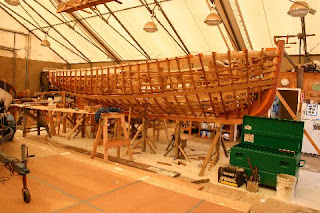
Peter Leenhouts of the Northwest School of Wooden Boatbuilding, Port Hadlock which is located on Washington States Olympic Peninsula, northwest of Seattle wrote with some details of a cruising tug which was launched in August of 2012.


Tug boat derived pleasure boats are popular in the US but very rare in Europe, perhaps that comment will elicit a flood of emails from European owners, if so please send photos and details wed live to feature more examples.


Back to the boat in question, it was designed by an American, H.C. Hanson in 1957 for the US Forest Service as a Scalers Boat. Scalers determine the amount of board feet of lumber in each log cut by a timber crew.

Three boats were built commercially in the mid-1950s to this design for the US Forest Service for use in the Pacific Northwest. Construction on this latest example began in 2010 and finished in 2012, with the schools classes of 2010, 2011 and 2012 all contributing to the build.


The tug is 26 feet long with a beam of about 7 feet, a draft of four feet and displacing around 4 tons.

Built as a cruising boat, the planking is aromatic port orford cedar from southern Oregon, over white oak frames. The cabin house sides are of mahogany. Power is supplied by a 39 hp Yanmar diesel engine.


 Not surprisingly the tug was quickly sold to an owner, who based in Michigan will use her to enjoy the fresh water of Traverse Bay.

Thanks to the Northwest School of Wooden Boat Building
Read More..

Jay Benford Cruising Dory Badger

Selasa, 12 April 2016

In 1978, Jay Benford expanded on his cruising experience in the 34 foot topsail ketch, Sunrise, to create a dory hulled cruising boat. There were naysayers then, as now, about the capacity of a sailing dory to weather off-shore conditions.


 Annie and Pete Hill made the Badger famous and proved Mr Benfords design by sailing their dory over 100,000 nautical miles. Since then, we find Benford Badgers being built everywhere. It is a cruising yacht designed for the home builder.


Annie, of course, loved her plywood dory and had this to say in her book Voyaging on a Small Income:
"Badger can be built simply and for very little money. Sheathed in cloth and epoxy, she is easy to maintain and can be kept up to standard at very little expense - an essential prerequisite for a boat that is sailed on a small income." 
The Badger was originally designed with a cutter sail rig, but most builders prefer a fully battened schooner junk configuration, which has been touted as possibly the best short-handed cruising rig ever devised.


In Ullapool, Scotland we find a recently launched Badger setting out for its first cruise. Dan Johnson is the happy builder of Hester. He and his wife Charlotte Watters have spent several years exploring northern Atlantic venues, so for their first cruise on Hester, will be heading south.


Dan, with occasional help from friends, built Hester in two years. An impressive schedule for readying an open-ocean cruiser and a testament to Annies claim about simplicity of build, also to the commitment of the builder.


Dan and Charlotte have been impressed with the boats handling, as documented in Dans log:

"...we had made it down to Oban where we left Hestur for a week. After that, Charlotte and I returned to sail north again back to Ullapool. Of course we were hit by five days of northeast winds (absolutely our direction of travel) This would really show us how Junks go to windward - they do."

"Heading north we decided to go inside Mull then outside Skye taking in the Outer Hebridies. This proved to be a good plan as the Minch provides a great seaway for tacking against northerly winds! Heading west across the Minch towards Barra we experienced our first largish sea and strongish wind aboard Hestur - F6 with 10 foot crashers. She performed perfectly with nothing unexpected and we were broad reaching at 6+ knots with two panels up on the foresail and three in the main. Very easy sailing with no deck work - all reefing done from cockpit"

"When sailing on the wind she will sail herself if you balance the sails - we often leave the helm quite literally for hours and hours, not even lashed. This surprises me as she is a fin keeler - I think it must be the substantial skeg arrangement."

Being a dory sailor myself, I find this account impressive and would like to offer congratulations to Dan and Charlotte. May they find many happy miles at sea!

Thank you, John McIntyre and Chris Perkins of Ullapool for the photos of Hester.

Doryman

Read More..

Cape Henry 21 Trailer Sailer Cruising

Senin, 04 April 2016

Richard Hunter lives in Czech Republic and bought himself a Cape Henry 21 that was built in UK by amateur builder Gary Wallis. He sails it mostly on Berzdorfer See in Germany. He recently towed it 1200km to Croatia with a 1.9 litre VW Transporter to cruise in the waters of Croatia. With his wife and three teenagers on the trip, they used the van and boat as overnight accommodation en-route.
Cape Henry 21 "Ruby" reaching in great sailing conditions
Once in the water, they set off with everything needed by the 5 people and cruised for a week, without having to put into harbour to stock up. Their little cruiser took it all very well, allowing them to anchor close to shore in private spots that are inaccessible to the much bigger charter boats. Their boat is quick in the conditions normal to that area in summer, even with the big load that she was carrying. They found themselves enjoying great sailing while the big charter boats went by, motoring port-to-port.

Stowage nets for stores for 5 people.
 Richard sent me a video and photos recording their holiday, as well as some nice writing about the experience. He sums it all up in a few sentences.
 

The Cruising Rowboat

Rabu, 16 Maret 2016

Some boats just grab your imagination and keeps it working overtime. The Camper Rowboat from Angus Rowboats is just such a boat. Im up way past my bedtime and cant stop dreaming of the adventures awaiting me if I only build this boat!


To understand the boat you need to know a little about the designer. Colin Angus and his wife, Julie, have collectively rowed more than 40,000 kilometers in a variety of oar-powered craft on oceans, rivers and lakes. Julie Angus made history by becoming the first woman to row across the Atlantic Ocean from mainland to mainland. Colin is the first to row across the Bering Sea from Alaska to Siberia, and he has also voyaged by oar down the length of the Amazon and Yenisey Rivers.

They live on Vancouver Island. Maybe I should say they are based on Vancouver Island, from which they launch their adventures. Outside Magazine listed Colin as one of the top 25 "bold visionaries with world-changing dreams" for his work in promoting lifestyle changes to help the environment.

This new boat looks similar to the one the duo used to row and bike 7,200 kilometers from Scotland to Syria. That boat, the Expedition, is a sliding-seat rowboat built for the open ocean with the capacity to store a bicycle and the boats trailer in the main water-tight compartment, making the rower/biker amphibious.


At 19 feet and 175 pounds fully rigged, the Camper is about a foot longer. Instead of stowing a bike, the main compartment is now a bedroom. Other innovations include two small pontoons that attach to the outboard ends of the rowing outrigers while at anchor to make the boat a stable platform for lounging, cooking and sleeping.

Angus says the hull shape of the Expedition and the Camper boat are quite different. The Camper is made from eight panels with a V-bottom. The Expedition is made from five panels and has a flat bottom. Both are beautiful boats and look like they would be a blast to row.


(Note to Colin: Please come up with a better name than "Camper." It congers up visions of eating baloney while seated on the tailgate of a Buick Roadmonster stationwagon. Or, worse, elderly RVers driving a half the speed limit.)

The plans for the Expedition are available now from Angus Rowboats, but we will have to wait until fall for the Camper plans.

This summer Colin will attempt to beat the current circumnavigation record of Vancouver Island, which is just over sixteen days (done in a kayak). He will use an Expedition and figures he will need to cover about 75 kilometers a day in a range of conditions.


My optimum use of the Camper, should I ever build one, would be to row a leasurely dozen or so miles between anchorages in, say, Washington states San Juan Islands. Meantime, the Anguses are planning a non-stop double circumnavigation of Vancouver Island next year with two people in the boat, each taking turns rowing 12 hours a day. (Cant you guys give it a rest; You make me tired.)

Maybe you should rename the boat the Circumnavigator Express. Yah, thats more like it!
Read More..

Regarding the mythical 500 a month cruising budget

Kamis, 10 Maret 2016

In the "lest we forget" department, some scary reading, and taking dead, discarded materials and bringing them back to life...

Writing Boat Bits, Im often reminded that different folks have very varied experiences with boats, the sailing of such things, and cruising. That said, Im surprised at just how often tunnel vision becomes part of the mix.

For instance, the $500 dollar cruising budget...

Not too long ago I found myself on the receiving end of a reader rant that went on for about a dozen emails explaining to me how the $500 cruising budget was simply impossible. To prove his point he illustrated said emails with copious notes of how much he had to pay while cruising over a three year period. As it happens he was right because there is no way he could have cruised on $500 a month.

For starters, he had a newish 52-foot boat...

He didnt like to anchor so always chose marinas whenever possible...

Admittedly, not a very handy person, so most all maintenance and repairs were done by various contractors or marine businesses...

Loved to eat out and something of a food snob or so he said...

Had grandchildren (with more on the way) that he and his wife felt the need to visit on a regular basis...

So, yeah, not exactly a candidate for a $500/1000/1500/2000/2500/3000 monthly cruising budget and, in fact, told me he could not even imagine how someone could sail or cruise on less than he spent.

Im pretty sure the key word in all of that is "imagine" because to do something you really have to be able to see it in your minds eye before you can make it a reality.

As far as Im concerned there is zero wrong with the guys cruising budget or the way he chooses to cruise. He obviously has deep enough pockets to support that sort of lifestyle so all power to him. On the other hand, do I think he has a clue about cruising budgets for folks of, shall we say, shallower pockets or people who have simpler less expensive tastes? Well, the word clueless does jump to mind.

Which brings us to the same old same question...

Can you cruise comfortably on $500 a month and the answer is, more than likely, maybe not.

But, if you can imagine it with no rose colored glasses in the mix maybe you can...

Listening to a whole lot of John (who would have been 75 this year) Lennon covers

So it goes...

Read More..

Seating Positions in Cruising Dinghies

Kamis, 03 Maret 2016

Im now nearly 57 years old, and for most of my life Ive been sailing small cruising and racing dinghies.

As far as Im concerned, there are only two places to sit - either on the bottom of the boat with ones weight in the turn of bilge, or on the gunwale/side decks to work the boat in heavier conditions. I love the inside position, as the side-deck carlins support the back and shoulder blades nicely, the view is unobstructed by the sails, and there is an enhanced sense of speed due to having sight lines which are closer to the surface of the water.

You may have seen this photo before, but it shows two of my sons and me at the end of a nice afternoon sail on Moreton Bay. Conditions outside had been quite lively, but the only person who had to change sides was the skipper.

The above photo shows the relaxed position, and the one below shows the only other position I think worth considering.
That is me, enjoying a gentle afternoon sail in my wooden International Finn.  This particular boat was built for the 1956 Olympic Games. In a Finn you need to be hiking out in just about any wind.
Despite what Ive just said, there is still a strong demand for side seats from people who enquire about my dinghy plans. On paper these side seats appear to be very comfortable and convenient, but in my experience they rob the interior of the boat of room to move, and the seating position is neither one thing nor the other. The crew end up too high to see under the sails, are too high to receive meaningful back support, and are too low to be able to hike out. Other than when hiking out on the rail, the turn of bilge sitting position provides the best live ballast location, and provides protection from the elements.

Ok! You now know where I think people should sit, but the fact is that many crew members like the idea of side seats. In order to give the option of side seating without ruining the boat, I have come up with an idea which provides removable side seating, and also solves one of the major problems when beachcruising in a small boat, which is where to sleep out of bilge water, with room to store gear.

The concept works on both my Phoenix III and First Mate designs, but is adaptable to many others. Paul Hernes, who built the first Phoenix III thought it worth a try, and here are some pictures.
This is Phoenix III showing the main thwart in the foreground and the stern sheets (aft thwart) in the middle distance. The aft edge of the main thwart and the forward edge of the stern sheets are parallel and at a similar level.
This is First Mate under construction. You can see the same arrangement of main thwart and stern sheets as in Phoenix III.  In fact both boats have identical internal arrangements - just the hull construction (and therefore, shape) are different. 
My proposed method involved gluing and screwing some 3/4" x 3/4" (19mm x 19mm) wooden cleats to the aft face of the main thwart, and to the forward face of the stern sheets, and dropping a pair of removable side seats onto those cleats. Easy to remove if required, and they can then be stored upright against the side of the centreboard case, taking up very little room. Better still, remove them altogether and leave them at home.....
This is Pauls Phoenix III with a nice set of side seats installed.
Another view. The cleats are hidden under the ends of the seats.
Now for the important part. My idea had been that the side seats could be slid into the centre of the boat, giving a sleeping platform which is up out of the bilge water, with stowage space underneath. After a nights sleep, the bunk flat turns back into side seats, or better still, gets removed and stowed alongside the centreboard case. The length for sleeping is the total of the width of the main thwart, the width of the stern sheets, and the length of the side seats - this turns out to be adequate for most normal-sized humans in these small boats, and the sleeping width is the accepted standard of 22 inches.
Pauls Phoenix III with the seats arranged for sleeping. The system works very well indeed.
So there you go, folks - multi-tasking!
Read More..

Tricorn A very early all GRP cruising dinghy

Senin, 08 Februari 2016

The Tricorn dinghy was designed by Illingworth and Primrose in 1962. Since theirs was one of the most famous names in offshore racing yacht design at the time, she came with some impressive pedigree. The design brief appears to have been to create a low maintenance dinghy, capable of serious open water passage-making, that would be better and faster than Ian Proctors well proven and famous Wayfarer class.

Back then in the early 60s there were very few dinghies purpose-designed for construction in GRP. Almost certainly this was the first boat of any type designed by Illingworth and Primrose for this type of construction, and at the time the Wayfarer would only have been available in plywood, so although Angus Primrose had certainly designed dinghies before, the Tricorn brief must have come as a considerable new challenge. His approach, in common with most other designers who were learning to work with this little known material, was make the boat strong and not to spare on materials. When you examine the layup of a Tricorn, youll notice a predominance of woven rovings throughout, and lots of reinforcement in areas where a contemporary wooden or plywood dinghy might have had a tendency to develop stress cracks or other weakness.

Very unusually for such an early fibreglass boat, there is almost no wood, except for the tiller, rudder, and some backing pads for deck fittings. This may have been a bit too avant-garde for the times, since boat enthusiasts in those days would have expected quite a lot of visible wood trim, coamings, decks, floorboards, benches, hatches, etc. The all plastic Tricorn might have been regarded as just too space-age and factory produced, and this perception, as well as its price and the narrowness of its marketing concept, may have seriously limited sales. Eventually only 37 were built.

Not that there was anything wrong with the performance of the Tricorn, nor its ability to shelter its crew of 2 adults, plus maybe a child, for overnight camping stops. Contemporary boat tests make it clear that Tricorn had the edge over the Wayfarer in both departments, although nowadays, after 50 years of Wayfarer class development, the Tricorn would probably struggle to keep up on some points.

Almost certainly, however, Tricorn would still show a Wayfarer a clean pair of heels to windward, since with her centreplate fully down she draws 1.6m (5ft 3in) to the Wayfarers 1.17m (3ft 10in). She is also a few inches longer overall and carries around 1sqm more windward sail. Compared to the Wayfarer, Tricorn is noticeably less stable at rest, though she stiffens up when under way.

Tricorns domed foredeck and short cabin roof enclose a cuddy with sitting space for 4 adults or sleeping space for 2 (in quarter berths extending under the cockpit side benches). There would be just enough space left over in camping mode for a child of up to about 11 years old to stretch out. Theres a large watertight locker aft, and two capacious cockpit side lockers, probably not really totally watertight in the event of capsize, but which resist rain, spray, and even a fair amount of solid water landing in the cockpit.

4 years or so ago, I found and bought an old Tricorn. It was very scruffy, had a hole in the bottom, and lacked its original moulded forehatch cover as well as the original winch for lifting the centreplate. This 1963 example had at some time been used as a sailing school boat and was fitted with a horrible non-original rusty steel plate, weighing in at 50kg or more, double the original design spec. In addition, the mainsail had been reduced in area by cutting the foot off it to a depth of about 1m. These modifications must have made her extremely slow and dull to sail.

Salvo is now back in sailing order with a few minor changes to her original specification. I changed the overweight rusty centreplate to one that weighs about 20kg, about the same as the original design, but mine is home-made from a sandwich of steel, epoxy and plywood. I had to give up on finding an original plate lifting winch and fitted a simple tackle instead. I made a forehatch cover from plywood and clear polycarbonate, and lastly, I changed from a transom mainsheet track to centre sheeting for no better reason than I was scared the sheet might foul on my outboard motor and cause a capsize. The old roller reefing boom was replaced by one from a Fireball, to which I fixed some fittings for slab reefing.

I made a new rudder blade cut from the plywood centreboard from an old Miracle dinghy, but it snapped in half in a fearsome tiderace in Brittany, so I have gone back to the original which I might repropuce in aluminium plate.

There are still a lot of niggling problems to sort out. For instance the original self bailers let more water in to the watertight cockpit than they remove, so my feet are always wet. The in-mast jib halyard emerges from the mast foot in such a way that it is difficult to tension properly. Im considering making it external from a point just below the spreaders so that I can swig it up tight. Most importantly, because of the total lack of rowlocks, a rowing thwart, and a stowage space long enough for decent oars, its impossible to row the boat in the event of flat calm and engine failure. Emergency propulsion consists of a long paddle at the moment.

In spite of the age of the design, and these minor shortcomings, I like my Tricorn.  She is a fine, strong, and capable boat - with one hell of a pedigree!  

Tricorn Sailing Dinghy
Designed by Illingworth and Primrose, 1962
Built by Martin Goacher Ltd.

LOA:  16ft 6in (5m03)
LWL:  15ft (4m57)
Beam:  6ft 2in (1m87)
Draft:  9in (0m22) plate up, 5ft 3in (1m60) plate lowered.
Air draft:  24ft 6in (7m46)
Sail area:  139 sq ft (12.91sqm)
Weight in sailing trim: approx. 580lbs (263Kg)

Link: http://bursledonblog.blogspot.co.uk/2012/05/tricorn-dinghy.html
Read More..

Cruising Aboard a Beneteau 423

Minggu, 31 Januari 2016

Finisterra at anchor in Bahia de Concepcion


As of today, weve owned Finisterra for a little over two years. During that time weve lived aboard for 10 months and sailed her about 6,000 miles including a six month cruise to Mexico and back.  We are preparing to depart again on another voyage and I thought now would be a good time to review my list of things that I would like to repair, replace, add or upgrade. As part of the process I considered what worked, what didnt, what we love and what we dont love about the boat. I categorized it all into the following groups:
Performance
Structure
Systems
Equipment
Comfort 


Performance
Weve always been pleased with the boats performance under sail. Its a cruising boat so the criteria for good performance are skewed toward ease of handling, safety and reliability in addition to pure boatspeed. If youre a regular reader of this blog, you know that I converted the rig from a roller furling mast to a classic. In doing so, I replaced the original mast with a new one from US Spars, added a Tides Marine sail track, lazyjacks and a stackpack, plus reefing lines and all the necessary blocks and clutches as well. Of course I also installed a new full-battened mainsail to go with the new mast. These changes improved the boats sailing qualities and made it safer. The new mainsail is more powerful than the roller furling sail so I was able to replace the standard 140% genoa with a 120% without any loss of power, and we sailed the entire 5,000 miles of our last voyage with this sailplan. With these sails we seldom had to reef and whenever we did, it was a simple process. In winds of 6 knot or more, Finisterra sailed well upwind and reaching. Downwind the boat suffered from a lack of power until the wind built to about 12-14 knots, but I expected that and considered it a good trade-off for a more easily handled boat in a breeze. We always sailed with a crew of two, which made me the deckhand and winch grinder, so easy boathandling is important to me. One thing I would like to improve is the rudder. I believe Beneteau uses the same one for the shoal and deep draft models, so it is a bit short. This makes the boat less responsive to the helm than a similarly sized racing yacht and, coming from a racing background, it is noticeable to me. 

Finisterra sails well with the apparent wind at 40 degrees or more. We could sail higher, but VMG drops off significantly and at less than 35 degrees apparent she just wallows along at 5 knots or less. If we had full on racing sails, we would certainly have been able to sail higher and faster than our cruising sails allowed. There were times when we pressed the boat hard upwind and it responded well, but with her thin keel and fairly wide sheeting angles, she doesnt like it all that much. Once we knew her sailing qualities we never asked more of the boat than she could deliver. 

The boat came with a fairly tired old spinnaker which we flew only a couple of times. I would like to replace it with a slightly smaller spinnaker that is in better shape. I want an AP kite that works well in 5-20 knots of wind and well keep shopping in the used sail market until we find one we like.

Finisterras performance under power is excellent. She is equipped with a Yanmar 4JH4E naturally aspirated diesel engine connected to a Slipstream 3 bladed folding prop. In flat water we have 7 knots of boatspeed at 2,100 RPM and a fuel consumption rate of about .8 GPH. Punching into a head sea, I would throttle up to about 2,300 RPM. I could have run the engine harder but never felt the need.

Structure
During the two plus years and 6,000 miles weve owned and sailed the boat, there have been no structural failures. Driving the boat hard upwind in 15 to 20 knots of wind for 24 hours revealed no leaks, the leeward shrouds remained taut, and we never felt any concern regarding the boats structural integrity. With that said, I must say I was disappointed in the construction of the aft-most bulkhead in the boat. My blog entry dated 4-6-2014 describes the issue. The bulkhead didnt fail, but it needed reinforcement. After that incident I went through the boat carefully, examining bulkheads, frames and reinforcements, and found no other reasons for concern. Is it the best boat ever built? Hardly. Is it sturdy enough to take us wherever we care to venture? I would say yes.

Much has been written about the pros and cons of glued versus tabbed bulkheads. Ive built many boats with carefully tabbed bulkheads and can attest to the strength, durability and cost of this type of construction. Virtually all of Finisterras bulkheads are glued into recesses in the boats fiberglass liner. If properly done, glued and tabbed bulkhead joints are in fact roughly equal. To my mind the more important question is how well the liner is bonded to the hull. In Finisterra it seems to be very well secured, so that loads are adequately transferred between the bulkheads and the primary hull structure. Still, I would prefer that the bulkheads be bonded directly to the hull whenever possible.There are other production boats that have bulkheads that are not as well secured as our boats, yet they soldier on year after year, with most of their failures, whenever they have them, in the engines and systems rather than the primary structures. There have been a few keel failures, or more accurately, hull/keel joint failures, on Beneteaus over the years. Google "Cheeky Monkey" for an example of the tragic consequences of such a failure. Finisterras hull/keel joint is massive and I would be surprised indeed to hear of a structural failure of this type on a Beneteau 423.

Our last boat, a Beneteau First 36s7 had a rudder that was supported by a fiberglass cone surrounding the rudder tube. It was pretty flexible and watching it move around when we were under sail was a bit disconcerting, but we never had a problem with it. The Beneteau First 42s7 has the same type of construction and I have first hand knowledge of one that sailed from Los Angeles to Australia with nary a problem, and another that recently completed a voyage from San Francisco to Denmark via the Panama Canal, also with no problems. Finisterra, like all Beneteau 423s, has a rudder tube that is supported by a set of longitudinal and transverse bulkheads, which is a much more robust arrangement. Ive watched for flex in this area while underway in various conditions and am pleased, and relieved, to report that there is no discernible movement of the rudder stock, even in fairly boisterous conditions.

Finisterras rig is just about perfect for the sailing we do. Its not a tall rig but it provides adequate power in all but very light conditions. The mast has double aft swept spreaders and is fitted with forward lower shrouds and double backstays. What I really like about it is that it is simple, reliable and well built. I have no concerns about the rig coming down.

Overall, I am pleased with the boats structural details. With a full fiberglass liner in the hull and the deck, we hear a bit of creaking when the boat is pressed, but that is to be expected with this type of construction. Flexing is an integral part of any structure and the key is to keep it within the allowable limits. I think Beneteaus boats are well thought out in this regard.

Systems
The electrical, mechanical and plumbing systems aboard Finisterra have been almost flawless since we bought the boat. Last year we installed new 6v AGM batteries, rewired the 12 volt system from the batteries to the DC panel and added an auxiliary DC panel. The previous owner had made some changes to the system that were not in accordance with ABYC standards so we corrected that, eliminated some wiring and simplified the system. I converted all the internal and external lighting to LEDs and added three solar panels. I wasnt sure that three 50 watt panels would be sufficient in all the situations we might encounter so I brought along a Honda 2000 genset on our voyage to Mexico, but we never needed it and I am considering leaving it home on our next voyage.

The engine has been the epitome of reliability. The previous owner had installed a 125 amp alternator in place of the standard 65 amp unit, which enables quick charging of the batteries. He also replaced the standard stuffing box with a PSS shaft seal and replaced the fixed 3-bladed prop with a folding unit and both have performed very well.  Aside from those improvements, the system is exactly as it was the day it was shipped from the factory.

The steering system is also original and has shown almost no signs of wear. The previous owner had replaced the steering wheel with a Lewmar folding unit which is not as strong as the standard wheel. Those folding wheels make moving around the cockpit easier while in port, but I prefer the solid feel of the original, so I put the old one back on and sold the Lewmar.

The plumbing system aboard Finisterra has also worked well. The boat had two electric heads when we bought it and one failed almost immediately, so I replaced both with simple and reliable Jabsco manual units. The gauge on the aft holding tank stopped working not long ago so I will diagnose and repair that before we leave on our next voyage.

Equipment
Watermaker:
When we bought the boat it was equipped with a Village Marine Little Wonder Model 200 watermaker. Its a simple and reliable unit that fits nicely under the forward part of the dinette. In southern California, where the water is usually less than 70 degrees F it produces about 7.8 GPH of pretty good water, in the 300-350 PPM range. In the warmer waters of Mexico, which sometimes reached 85 degrees, it produced water in the 450-500 PPM range. Its going on ten years old and I think its time to replace the membranes.

Ground tackle:
The Rocna anchor fits well in the Beneteau 423s stemhead. I changed both rollers on the starboard side to the type with a chain relief. Notice the chain stop just aft of the anchor.

The relief in the  Lewmar anchor roller helps prevent the chain from bouncing on the deck when raising or lowering the anchor.
Not long after we bought the boat I replaced the standard 3/8"BBB chain with 5/16" G4 and swapped the original 40 pound Bruce anchor for a 55 pound Rocna. This required changing the gypsy on the windlass. In doing so I found some corrosion on the windlass housing and ended up replacing the entire unit with a new Lewmar H2 unit. We now carry 200 of G4 chain, 150 of 5/8" nylon rode and the Rocna on the bow and a 35 pound Manson as a backup. The platform that the windlass is mounted on is dead level so the windlass almost always sits in standing water, which is why the housing corroded. I solved that issue by mounting the new windlass on a 3/4" high riser.

Electronics:
I converted the Raymarine wind, speed and depth instruments to a TackTick T104 wireless system. TackTick was recently acquired by Raytheon, which I guess is a good thing. Ive been using TackTick racing instruments for years and would never go back to the old wired system.


Tacktick system T108
TackTick T104 Wireless Cruising Instruments.
I added a Vesper wireless AIS system last year. With the amount of commercial traffic we encounter at sea, I find it to be invaluable. Because its wireless it talks to all of our laptops, Ipads and smartphones. Neither of our installed GPS receivers are wifi enabled so the AIS data dont show up on them, but we almost never use the Raymarine chartplotter, and use the cockpit mounted Garmin 551 mostly just for course keeping. The Vesper system has been flawless.

M802 Single Side Band Radio
Icom M802 SSB. 
I installed an Icom M802 SSB with a GAM antenna, and wouldnt go cruising without it. I plan to have Satphone capability on the next voyage though. The SSB is the more reliable communications device in places like the Sea of Cortez, its free and there are lots of radio nets that provide weather and other useful information, but I like the convenience of a Satphone in spite of the subscription cost. Iridium has just released their Go! device which enables any smartphone to communicate over their satellite network and acts as a hotspot as well. Im still researching the details, but this looks like a great solution for satellite voice and data.


Zodiac 250 Rib
The transom folds down to make a very compact package when its deflated.  It came with a nice nylon zippered bag but it faded quickly in the tropical sunshine. I had a cover made for it out of Sunbrella, which incorporates tie-down webbing straps to secure it to the deck . Photo courtesy of Zodiac Marine.

Danard dinghy wheels
Dinghy:
Our dinghy is a Zodiac 250 Rib with Hypalon tubes. At 82" long, its smallish for our needs but that is offset by its compact size when deflated, about 6 long x 3 wide and 10" thick when stowed on the foredeck.  It will plane with two aboard using our Tohatsu 6hp motor as long as we dont have a lot of groceries aboard. Of course planing is relative,  were traveling at about 15 knots with the engine wide open when were on a plane. We used only 3 gallons of gas in the six months we were in Mexico so the boat is very economical to run. Whenever we had a beach landing, which was all the time while we were in the Sea of Cortez, we used
Danard pinless dinghy wheels. They use pneumatic tires and are perfectly simple to operate. This is another piece of equipment I would not go cruising without.
We also brought along a Hobie inflatable kayak which we used often. Its perfect for cruising around quiet bays. If we had the space to store it, Id bring a second one on our next voyage.


Cookware:


We added a set of high quality stainless steel cookware from Magma. At first I was put off by the price but grew to love this equipment because it really is high quality, it nests together and they do a nice job of distributing the heat from the small burners on our stove. The removable handles enabled the entire set to be stored in a small locker under the stove. We also carry a Magma two burner propane grill, which we used extensively while in Mexico. Its another piece of equipment I wouldnt leave home without.

Comfort
The boat has been very comfortable to live aboard. The fixed dropleaf table in the cockpit was annoying and I replaced it with a small pedestal that serves as a drink holder and mounting base for the GPS. I had planned to fabricate a smaller fold-down table that would mount on the pedestal but didnt get around to it before we left for Mexico last January. On that trip we used a couple of small plastic folding tables that could be stowed out of the way when not in use. Now that were home Ive started making a new table, which will be done in a couple of weeks. The cockpit itself is big and comfortable and the step-thru to the transom/swimstep is very convenient. The previous owner installed a tankless propane water heater in the starboard lazarette, which provides lots of hot water without having to run the engine. This is especially nice for showering on the transom, which we did a lot of in the Sea of Cortez.

I like the tall, sturdy bulwarks and grippy nonskid on deck. They make moving around the foredeck easy even in rough conditions. Whenever we reef the mainsail I have to go to the mast to secure the tack, but aside from that, pretty much all boathandling tasks can be done from the cockpit.

Shade is vital in the tropics so we replaced the dodger, expanded the bimini and added removable mesh screens around the sides and back of the bimini. The screens do a fair job of blocking the sun while still allowing plenty of ventilation. But when its really hot outside, the most important accessory is the swim ladder and transom shower. A quick dip in the ocean followed by a freshwater rinse on the transom is the best way to beat the heat.


Below, we found the basic accommodations plan to be nearly ideal, but there are some details that would make it even better. For example, in the forward cabin , the Vberth should extend all the way to the hull on the sides. It would also be nice if there was a bit more counter space in the forward head. The main cabin proved to be adequate for entertaining up to six people comfortably and plenty spacious when there were just the two of us aboard. The galley has a lot of usable counter space and is quite large for a 42 foot boat, which makes day-to-day life aboard much more comfortable for the cook. The quarterberth is enormous and I rigged up a leeboard to make it a suitable sea berth. Thats where the off watch slept whenever we were at sea. The primary fuel filter, shaft log, batteries, water tank and a couple of storage spaces are all located under the quarterberth, but access to them was difficult because you had to pull out all the cushions and lift up the plywood bunk supports to get at them. So I built smaller access hatches into the panels that enable me to get at the fuel filter, shaft log and storage compartments without disassembling the entire bunk.
Lighting and ventilation in the 423 is excellent but we need a few more fans to keep the air moving, especially when were in the tropics.

Another item that vastly improved our comfort aboard was the small, 5,000 BTU air conditioner that I bought in Mexico. It was very much appreciated when the thermometer reached past 100 degrees, which it often did in La Paz. I had built a seat in the companionway awhile back, with the thought in mind that it would be a handy place for a portable AC unit, and it worked well.

Overall, the boat has been very comfortable and we have no plans to make any major changes before we head out on our next adventure.


Read More..

Cruising the Costa Alegre

Rabu, 27 Januari 2016

Finisterra departed from La Cruz on Thursday, January 8th, bound for beautiful Barra de Navidad. Our course took us in a southwesterly direction from La Cruz toward Cabo Corrientes, or Cape of Currents. After rounding the cape, we turned southeast along what is known as the Costa Alegre, or Happy Coast, so named because of the many beautiful coves and beaches along this coast all the way to Manzanillo.

After we left La Cruz the wind filled in nicely, about 12 knots out of the northwest. I hoisted the mainsail with a single reef and unrolled the jib. I put the reef in the main with the expectation that wed find plenty of wind around the Cape, as it often blows pretty hard there. We rounded the Cape around sunset with about 18 knots of wind on the beam, a bit lighter than expected, so it was a very pleasant sail. As night fell we bore off on a southeasterly course and the wind dropped to about 5 knots, still out of the northwest, so we started the engine and motored with the jib furled and main sheeted in tight. Its about 130 miles from La Cruz to Barra and we averaged about 6.5 knots over that distance and arrived early the next morning. We took a berth in the marina at the Grand Bay hotel and spent the next few days relaxing and exploring.


Grand Bay Hotel in Barra de Navidad


The marina is across a shallow channel from the town of Barra. To get there we took the dinghy and landed at a concrete sea wall adjacent to the old Sands Hotel.  To keep the wall from damaging the dinghy we put out a stern anchor.

Its not yet the tourist season in Barra so the town was pretty quiet, and this policeman was relaxing on a very pleasant morning. Notice his hat at lower right. 

Even in La Cruz, the marina was guarded by sub-machine gun toting policia. They are always friendly once they get to know you.


We had lunch at a waterfront restaurant. While their parents enjoyed lunch, local kids had a blast jumping off the railing.
We left Barra on January 13th and motored in no wind a few miles to Bahia Santiago and anchored in the northwest corner of the bay. The water temperature hovered around 83 degrees so it could have been very pleasant swimming, but it was too murky to see much. We spent a day walking along the beach and then took Finisterra around Punta Santiago and anchored off the Las Hadas resort for the next five days. Its a nice anchorage and we had a lot of fun hanging out with friends from S/V Unleashed. Unfortunately the cost to land a dinghy in the marina is now 200 Pesos per day (about $14 USD). There were half a dozen other boats in the anchorage and everyone grumbled about the cost of landing here. We have noticed a lot of price increases in everything, including food, fuel, slip rents, etc. everywhere weve been in Mexico compared to last year. While it is still possible to live more cheaply here than the US, things are changing quickly.

The beach in Bahia Santiago


Finisterra departed Las Hadas the morning of January 19th. This part of the Mexican coast, from Bahia Banderas all the way to Huatulco is known for its light air and for the next 185 miles we motored over a flat sea and no more than three or four knots of wind, with the exception of a few occasional puffs out of the northeast. The water temperature rose to 84 degrees and humidity hovered in the 80% range. With these conditions the air is always a bit hazy. We spent a good part of the day dodging long lines but eventually got far enough out to sea to avoid them. Of course that put is out in the shipping lane, where there is a lot of traffic. Fortunately we are able to spot ships with our AIS system and we had no trouble avoiding them.
Finding Internet access is always an interesting, or frustrating, experience in Mexico. At the Paradise restaurant overlooking the anchorage we found a well stocked bar, free wifi, and a big screen TV where we watched Seattles improbable win over the Packers.
Finisterra anchored off Las Hadas

We anchored on the northeast side of Isla Grande, Ixtapa around 1700 on January 20th and immediately jumped overboard for a refreshing swim. While at anchor there we scrubbed Finisterras bottom, which had developed a fair amount of growth since it was last cleaned in La Cruz. The next day we came into Marina Ixtapa, where well stay a few days before heading south to Acapulco.


Read More..